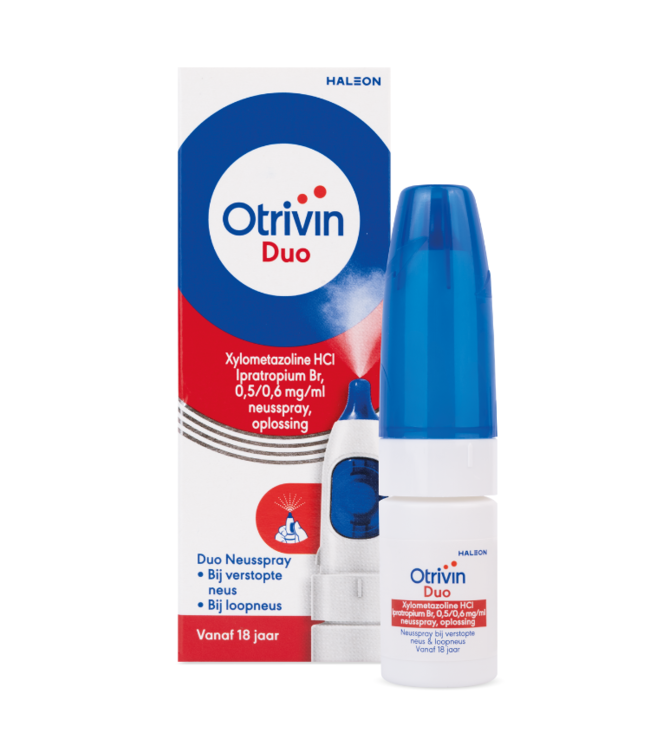
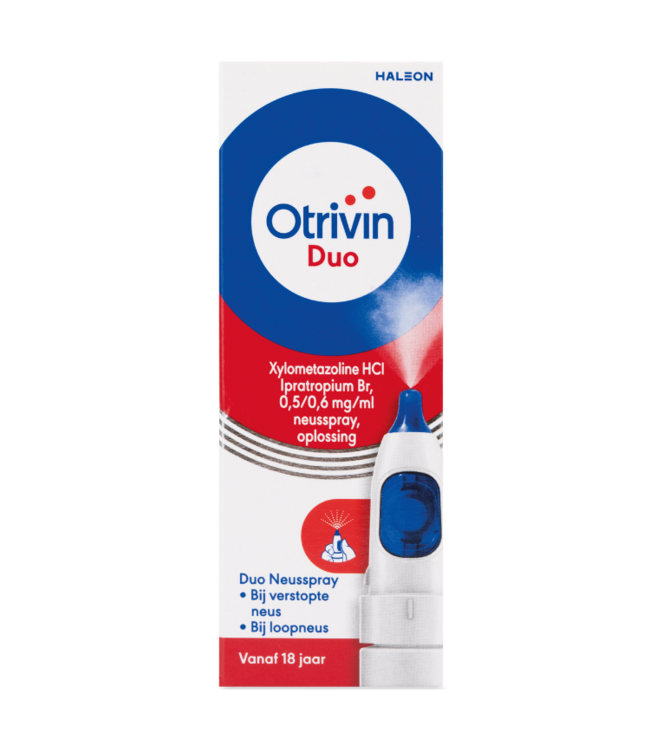
Otrivin Duo is used for the treatment of nasal congestion with a runny nose (rhinorrhea) associated with a common cold. Read more.
Otrivin Duo is a combination medicine consisting of two different ingredients. One of the active ingredients helps against a runny nose, while the other ingredient reduces swelling.
Otrivin Duo is used for the treatment of nasal congestion with a runny nose (rhinorrhea) associated with a common cold.
When should you not use this medicine?
Are you sensitive to medication for a stuffy nose? If so, this medication may cause you to experience problems sleeping, dizziness, shaking (tremor), an irregular heart rhythm, or high blood pressure. Contact your doctor if these symptoms occur and are bothersome.
Contact your doctor or pharmacist before using this medicine if you suffer from:
Immediate hypersensitivity (allergic reaction) may occur. This may manifest as an itchy red skin rash with inflammation of the skin (hives), difficulty breathing and speaking, or difficulty swallowing due to swelling of the lips, face, or throat. These symptoms may occur individually or in combination in the event of a severe allergic reaction. If this occurs, STOP using Otrivin Duo immediately (see section 4).
Otrivin Duo should not be used for more than 7 consecutive days. If symptoms persist, consult a doctor. Prolonged and excessive use may cause the nasal congestion to return or worsen and may lead to swelling of the nasal mucosa.
Avoid spraying Otrivin Duo in or around the eyes. If this happens, rinse the eyes thoroughly with water. Your vision may become temporarily blurred and the eyes may be irritated, painful, and red. If this occurs, contact your doctor for advice. Closed-angle glaucoma may also worsen.
The use of Otrivin Duo in children and adolescents under the age of 18 is not recommended due to a lack of sufficient documentation regarding safety and efficacy.
Are you using any other medicines in addition to Otrivin Duo, or have you done so recently, or is there a possibility that you will use other medicines in the near future? If so, tell your doctor or pharmacist. It is especially important that you mention the following:
If you are using one of the medicines mentioned above, consult your doctor before using Otrivin Duo.
Otrivin Duo should not be used during pregnancy unless your doctor recommends it. During breastfeeding, Otrivin Duo should not be used unless your doctor decides that the benefits outweigh the possible danger to the child.
Are you pregnant, do you think you might be pregnant, do you want to become pregnant, or are you breastfeeding?
Please contact your doctor or pharmacist before using this medicine.
Visual disturbances (including blurred vision and pupil dilation), dizziness, and fatigue have been reported with the use of Otrivin Duo. If you experience these symptoms, avoid driving, operating machinery, or participating in activities where these symptoms endanger yourself or others.
Always use this medicine exactly as stated in this leaflet or as your doctor or pharmacist has told you. If you are unsure about the correct use, contact your doctor or pharmacist.
The recommended dosage is:
Adults: one spray in each nostril as needed, up to 3 times a day and for no longer than 7 days. A period of at least 6 hours must be observed between two doses.
Do not use more than 3 sprays per day in each nostril.
Do not use more than the dose stated above. Use the smallest dose you need to treat your symptoms. Use this dose for the shortest time necessary to achieve a good effect.
Duration of the treatment:
Do not use this medicine for longer than 7 days.
It is advisable to stop treatment with Otrivin Duo as soon as the symptoms improve. Do this even if this occurs sooner than 7 days, to reduce the risk of side effects. If the symptoms do not improve after 7 days or even worsen, contact a doctor.
If you think that the effect of Otrivin Duo is too strong or too weak, consult your doctor or pharmacist.
Method of administration:
Remove the protective cap.
Do not cut the nozzle. The dosing spray is ready to be charged for use.
Before the first administration, charge the pump by pumping 4 times. Thereafter, the pump will remain charged normally during periods of regular daily treatment. If the spray is not dispensed upon pressing, or if the product has not been used for more than 6 days, the pump must be recharged by pumping 4 times, just as before the first administration.
To ensure that the infection does not spread, the spray may be used by only one person.
Do not spray this medicine in or around the eyes.
The effect occurs after 5 to 15 minutes.
If you or someone else has used more of this medicine than you should, consult your doctor or go to the hospital or emergency department for a risk assessment. It is recommended that you take this leaflet, the bottle, or the packaging with you. This is particularly important for children, as they are more susceptible to side effects than adults.
Symptoms of an overdose include severe dizziness, sweating, significantly lowered body temperature, headache, slowed heart rate, accelerated heart rate, difficulty breathing, coma, convulsions, hypertension (high blood pressure) possibly followed by hypotension (low blood pressure).
Other symptoms include a dry mouth, blurred vision, and hallucinations.
Do not take a double dose to make up for a missed dose.
Do you have any other questions about the use of this medicine? Please contact your doctor or pharmacist.
Like all medicines, this medicine can have side effects, although not everyone experiences them.
STOP using Otrivin Duo and seek medical help if you experience any of the following symptoms:
The most frequent side effects are nosebleeds and a dry nose. Many of the reported side effects are also symptoms of the common cold.
Side effects that occur very frequently (in more than 1 in 10 users):
Side effects that occur frequently (in less than 1 in 10 users):
Side effects that sometimes occur (in less than 1 in 100 users):
Side effects that rarely occur (in less than 1 in 1,000 users):
Side effects that occur very rarely (may affect up to 1 in 10,000 users):
Frequency unknown (cannot be estimated from the available data):
Have your symptoms decreased? The advice is to stop treatment with this medicine immediately. This reduces the risk of side effects. Also stop the treatment if your symptoms have already decreased within 7 days.
If you experience side effects, contact your doctor or pharmacist. This also applies to possible side effects not listed in this leaflet. You can also report side effects directly via the Netherlands Adverse Reactions Centre Lareb (www.lareb.nl).
By reporting side effects, you can help us obtain more information about the safety of this medicine.
Keep out of sight and reach of children.
Do not use this medicine after the expiry date. This can be found on the label after EXP. A month and a year are indicated there. The last day of that month is the expiry date. This date also applies if the packaging has been opened.
Store below 25°C
Do not flush medicines down the sink or toilet and do not throw them in the trash. Ask your pharmacist what to do with medicines that are no longer needed. They will then be destroyed in a responsible manner and will not end up in the environment.
What substances are in this medicine?
Otrivin Duo is a clear solution.
The bottle contains approximately 70 sprays.
Otrivin Duo is available as a 10 ml nasal spray with a pump for metered doses.
Marketing authorisation holder:
Haleon Netherlands BV
Van Asch van Wijckstraat 55G
3811 LP Amersfoort
The Netherlands
www.otrivin.nl
Registered in the register under: RVG 102338
View this medicine in the Medicines Information Database
Please note: This product is only available for shipping within the Netherlands. Unfortunately, orders from other countries cannot be processed.
We have the necessary authorization to sell UAD medicines in the Netherlands :

Find the order you'd like to withdraw
Enter your email address and order number.
Check your mailbox
If your details match an order, you'll receive an email with a link to view and manage it.