





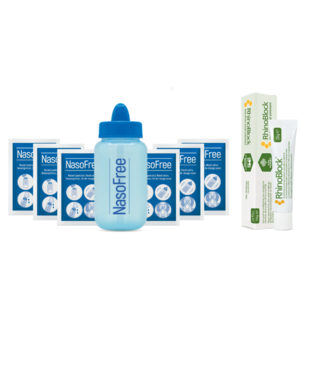

Nasal rinse
For cold symptoms and nasal complaints caused by allergies (such as hay fever or house dust mite allergy), rinsing the nose with a nasal douche, also known as a nasal irrigator, can help. A nasal douche is a tool for rinsing the nose. This reduces debris in the nose and sinuses, such as viruses, bacteria, and pollen. Less debris in the nose means fewer nasal complaints.
For which symptoms or in which situations do you use a nasal rinse?
You use a nasal rinse for:
- Cold symptoms
- A (Respiratory) allergy
- Infection or inflammation
- After a nose operation
- For periodic cleaning
- To rinse unwanted substances out of the nose: such as polluted air, dust, or pollen
How does a nasal rinse work?
Using a nasal rinse is effective and comfortable, as long as you rinse in combination with nasal saline . This is a special type of salt developed for cleaning the nose and sinuses. It prevents irritation of the nasal mucosa.
Why rinse with nasal saline solution?
There is often debate about saline solution: can you make it from ordinary table salt, or do you need to purchase special nasal rinse salt? ENT doctors say: use nasal rinse salt. Because that is specially developed for cleaning the nose (and sinuses).
Ordinary 'table salt' is not intended for cleaning your nose. You can use it in a nasal rinse, but that is often perceived as harsh. Moreover, table salt usually contains iodine, a substance that irritates the sensitive nasal mucous membrane.
Nasal rinse salt has been specially developed for cleaning the nose. The salt content is precisely matched to that of your nasal mucosa. As a result, it does not irritate and works effectively to clean the nose and sinuses.
Nasal rinsing in 5 steps
By rinsing your nose with a nasal douche, you flush out all dirt, allergens, and mucus. These crusts and mucus are drained through the other nostril. In this way, your entire nose is thoroughly cleaned. However, this naturally requires some light preparatory work, such as preparing the saline solution, filling the nasal douche, and inserting the liquid into both nostrils. You can read exactly which steps are involved in the blog below.
Nasal rinsing with saline in five steps
Research into nasal rinses
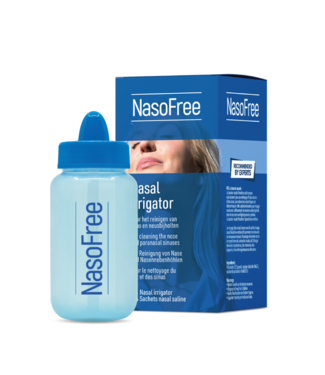
Research has shown that a good nasal rinse must meet a number of criteria. Based on this, the NasoFree nasal rinse was developed in collaboration with ENT specialists. This is a nasal rinse that works based on squeezing force. However, there are also other types of nasal rinses. Choose the nasal rinse that you think suits you best.
What types of nasal rinses can you find at KNO-winkel?
At KNO-winkel, we distinguish between squeeze-bottle nasal rinses , nasal irrigation devices , and electric nasal rinses . All three are used to rinse a saline solution through the nose. The way the rinsing pressure is generated differs by type.
Nasal douche with squeeze bottle
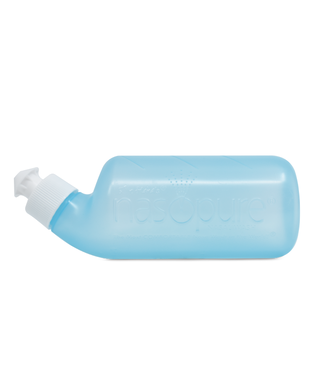
With a squeeze bottle nasal rinse, you squeeze the bottle yourself to let the saline solution flow through the nose. Various names are used for this type of product.
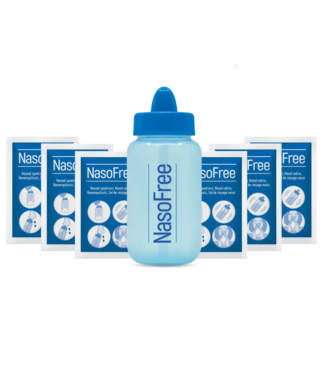
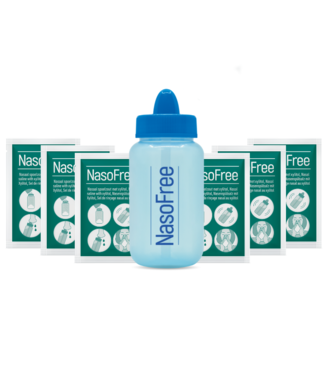
Examples are NasoFree , NasoPure , and Rhinicur .
Nose can
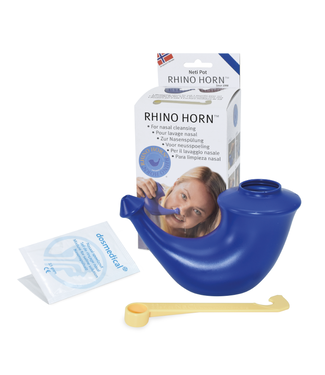
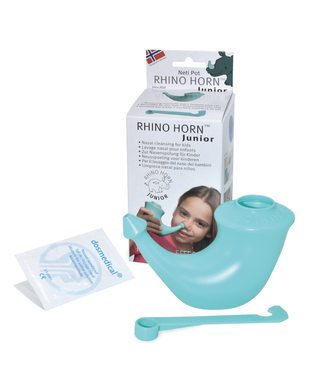
With a nasal irrigator, the saline solution flows through the nose with the help of gravity. To do this, you tilt the irrigator and hold your head in the correct position.
The Rhino Horn is an example of a nose hawk.
Electric nasal shower
With an electric nasal douche, the saline solution is guided through the nose using an electric system. Depending on the device, you can adjust the rinsing setting.
You use an electric nasal douche, just like other nasal douches, in combination with a saline solution to rinse and clean the nose.
NasuClear is an example of an electric nasal douche.