




Nasal rinse
For cold symptoms and nasal complaints caused by allergies (such as hay fever or house dust mite allergy), rinsing the nose with a nasal douche, also known as a nasal irrigator, helps. This flushes out excess mucus /snot , crusts, pollen, and other particles from the nose and sinuses. As a result, nasal symptoms can be reduced .
For which symptoms or in which situations do you use a nasal rinse?
You use a nasal rinse for:
- Cold symptoms
- Allergic nasal complaints, for example due to hay fever or house dust mite allergy
- An inflammation or infection of the nose or sinuses;
- After a nose operation
- To rinse pollen, dust, and other particles out of the nose.
How does a nasal rinse work?
With a nasal rinse, you flush a saline solution through the nasal cavity. The liquid enters through one nostril and flows out through the other. In this way, mucus, crusts, pollen, and other particles can be washed away.
For rinsing, you can use nasal rinse salt . This is rinse salt specifically for cleaning the nose and sinuses. The composition is tailored to the nasal mucosa.
Why rinse with nasal saline solution?
There are several ways to make a saline solution for nasal rinsing. You can use regular salt for this, but also special nasal rinse salt. Some ENT doctors recommend nasal rinse salt, because it is specifically formulated for use in the nose.
If you make a saline solution yourself using table salt, it is important to use the correct ratio of salt to water. A solution that is too strong or too weak can feel unpleasant or irritating.
Nasal rinse salt is intended for cleaning the nose and sinuses. In pre-packaged sachets, the amount of salt is already matched to a specific amount of water. As a result, you do not have to determine the ratio yourself.
How do you use a nasal rinse?
First, prepare the saline solution and fill the nasal douche with it. Then, rinse the solution through one nostril so that it flows out through the other. Repeat this for both sides.
The exact method of use varies depending on the type of nasal douche. Therefore, always follow the product's instructions for use.
Do you use a nasal irrigation device or a nasal douche with a squeeze bottle? We explain how to use them in 5 simple steps: saline nasal rinsing in five steps .
What types of nasal rinses can you find at KNO-winkel?
At KNO-winkel, we distinguish between three types of nasal rinses:
- nasal rinses with a squeeze bottle;
- nasal irrigators;
- electric nasal rinses.
With all three, a saline solution flows through the nose. They differ mainly in the way the rinsing pressure is generated.
Nasal douche with squeeze bottle
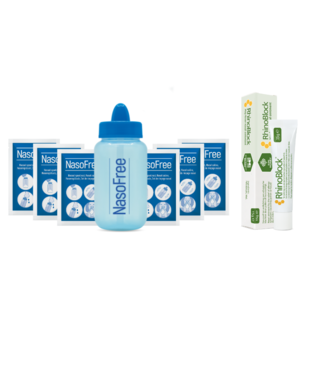
With a squeeze bottle nasal rinse, you squeeze the bottle yourself to let the saline solution flow through the nose. Various names are used for this type of product.
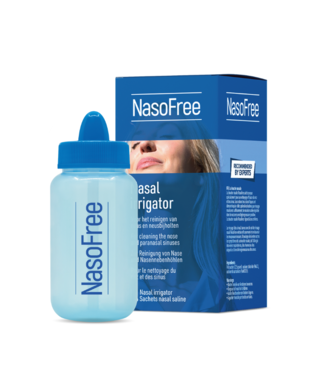
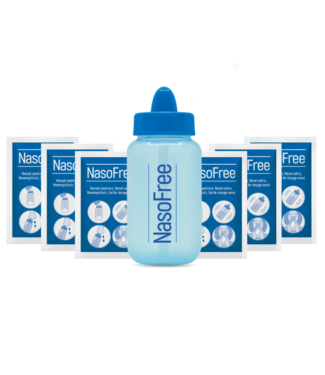
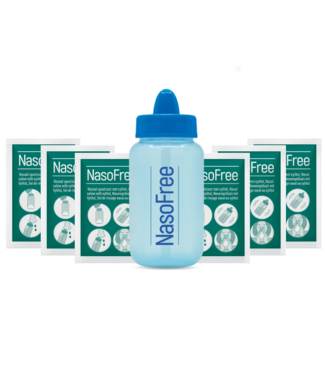
In our assortment, you will find NasoFree and Rhinicur .
Nasal canister
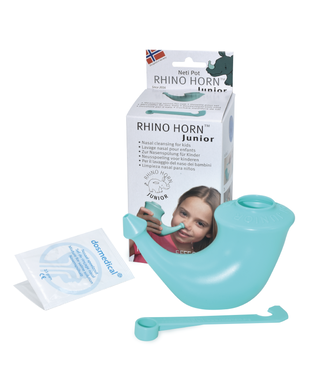
With a nasal irrigator, the saline solution flows through the nose with the help of gravity. To do this, you tilt the irrigator and hold your head in the correct position.
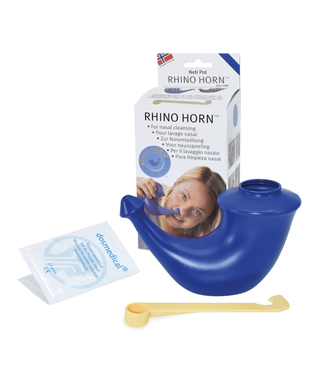
In our assortment, you will find Rhino Horn .
Electric nasal shower
With an electric nasal douche, the saline solution is guided through the nose using an electric system. Depending on the device, you can adjust the rinsing setting.
You use an electric nasal douche, just like other nasal douches, in combination with a saline solution to rinse and clean the nose.
In our assortment, you will find NasuClear .
Nasal cleansing for babies
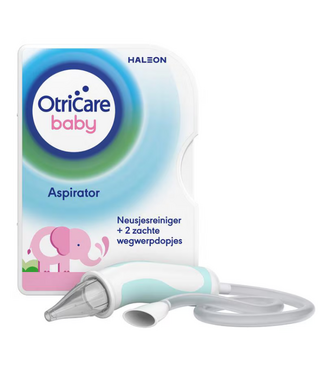
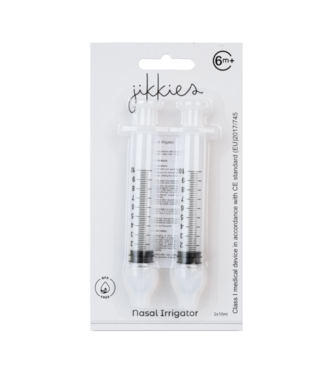
For babies, there are special tools to remove excess mucus from the nose. This can be done by rinsing the nose with a saline solution or by suctioning away the mucus. You can choose from two types of tools for this.
The Jikkies nasal aspirator is a tool that you use in combination with a saline solution to comfortably and easily rinse mucus from the nasal cavities.
The Otrivin Baby Aspirator works using suction. With it, you can easily and hygienically remove excess mucus from your baby's nose. An absorbent filter catches the mucus.